

Kentucky 2026 HB 714
The Prenatal Equal Protection Act
Overview
Filed by Kentucky State Representatives Richard White and Josh Calloway
Provides Equal Protection to Preborn Children
If we truly believe that a fetus is a person made in the image of God, then to be consistent with the Constitution and God’s Word, the laws which protect human beings who are born must equally protect those who are not yet born.
“No state shall deny to any person within its jurisdiction the equal protection of the laws.” U.S. Constitution, 14th Amendment.
“There are inconsistencies between Fourteenth Amendment status and the typical abortion statute. If the fetus is a person, why is the woman not a principal or an accomplice? If the fetus is a person, may the penalties be different?” Supreme Court of the United States. Roe v. Wade, 410 U.S. 113, 157-58 n. 54 (1973).
“All men, when they form a social compact, are equal; and no grant of exclusive, separate public emoluments or privileges shall be made to any man or set of men.” Kentucky Constitution, Bill of Rights, § 3.
“So whatever you wish that others would do to you, do also to them, for this is the Law and the Prophets.” The Golden Rule. Matthew 7:12.
“You shall love your neighbor as yourself.” Mark 12:31.
“You shall not be partial in judgment.” Deuteronomy 1:17.
Does the bill criminalize women?
No. The bill criminalizes the act of knowingly and voluntarily causing the death of a preborn child.
To deter such conduct and to provide equal protection of the laws, the bill does prohibit everyone, including pregnant mothers, from engaging in the unlawful act of prenatal homicide.
Once the bill is passed and becomes effective, the justice system would determine on a case-by-case basis whether any report of suspected prenatal homicide would be investigated and prosecuted and for what charge, and whether anyone would be convicted and sentenced. This justice system includes:
Law enforcement
Prosecutors
Grand juries
Trial juries
Judges
Multiple appellate courts
Governor
All defendants would have the right to an attorney, the right to remain silent, and all other constitutionally required due process. The state would bear the burden of proving its case beyond a reasonable doubt.
Finally, before any sentence could be imposed upon any defendant, the people participating in that justice system process would be required to be in nearly unanimous agreement that the process and outcome were just.
FAQs
Kentucky: Overall Abortion Numbers are Rising
Despite the recently enacted Human Life Protection Act, Kentucky babies are still being aborted on a horrific scale. Based on conservative projections, over 6,924 Kentucky preborn babies were legally murdered in 2024 as allowed by current law.[1] At least 2,455 occurred out of state,[2] while another 5,166 Tennessee mothers legally performed DIY at-home abortions using the abortion pill.[3]
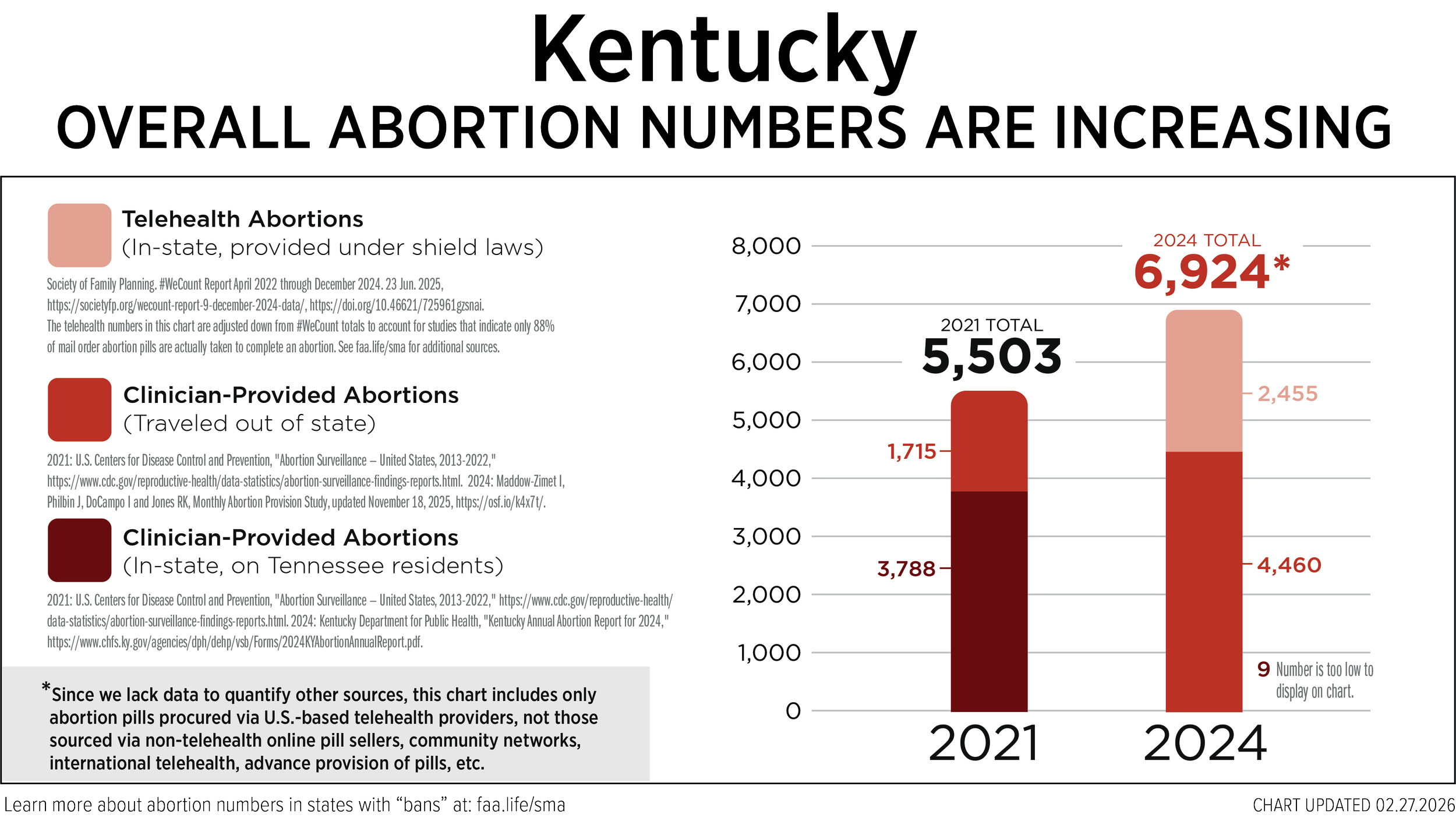
NOTES:
KRS § 507A.010(3) and 311.772(5)
Maddow-Zimet I, Philbin J, DoCampo I and Jones RK, Monthly Abortion Provision Study, updated November 18, 2025, https://osf.io/k4x7t/
Society of Family Planning. #WeCount Report April 2022 through June 2025. December 9, 2025, https://societyfp.org/wecount-report-9-december-2024-data/, https://doi.org/10.46621/725961gzsnai. The telehealth numbers in this chart are adjusted down from #WeCount totals to account for studies that indicate only 88% of mail order abortion pills are actually taken to complete an abortion. See the Babies Unprotected report for additional sources.
Didn’t the Human Life Protection Act (the “trigger bill”) already outlaw abortion in Kentucky?
No. It only regulates abortion by prohibiting third parties like clinics from performing abortions.
However, it allows pregnant mothers to “self-induce” their own abortions throughout the pregnancy. This also means that, up to a point, it remains legal for others to pressure pregnant mothers into aborting their babies.
Could anyone who has been involved with an abortion in the past be prosecuted?
No. Retroactive application is explicitly prohibited by the Kentucky Constitution, the U.S. Constitution, and by the bill itself.
Could the bill punish women who have had miscarriages?
No. The bill explicitly provides that it does not apply to miscarriages.
Would the bill allow doctors to deal with medical emergencies like ectopic pregnancies?
Yes. The bill explicitly allows this.
SECTION-BY-SECTION
Bill Preamble
This preamble, while not legally binding, serves to describe some of the constitutional foundations of the bill as well as providing a general summary of its effects.
Bill Section 1
This section makes clear that Kentucky homicide law equally protects preborn children.
This section also makes clear that all existing due process protections for those accused of homicide of a born person would also apply to those accused of homicide of an unborn person, such as:
Presumption of Innocence. A person is presumed innocent until the state proves beyond a reasonable doubt that the person is guilty.
Mistake of Fact Defense. A person who misunderstands a material fact of what they are doing is not guilty if such mistake negates the existence of the mental state required by the offense.
Laws of Parties. Everyone willfully involved with the homicide can be prosecuted, including an abortionist and anyone who pressures the mother into the abortion.
Clemencies. The Governor can exercise executive clemency and commute or reduce the sentence of or completely pardon a person, even if the person had been lawfully convicted and sentenced (See Kentucky Constitution § 77).
Bill Section 2
This section makes clear that bill does not apply to medical care resulting in the unintentional injury or death of an unborn child resulting from lifesaving procedures undertaken to save the life of a pregnant mother when accompanied by reasonable and available steps to save the life of the mother ’s unborn child. This provision is consistent with the Dublin Declaration.
The bill does not apply to a spontaneous miscarriage, which is the accidental or natural death of a preborn child.
Bill Section 3
This section ensures that the terms “person” and “human being” include an unborn child in Kentucky homicide law, also making clear that spontaneous miscarriages cannot be penalized.
Bill Sections 4, 5, and 6
These sections are substantively identical to sections 1, 2, and 3 related to homicide, but they relate to assault.
Bill Section 7
This section gives the state Attorney General concurrent jurisdiction to prosecute in case local prosecutors refuse to enforce the law. There is precedent for this in Kentucky (See K.R.S. §§ 15.190—15.243).
Bill Section 8
This section is merely statutory clean-up based on the changes made by other sections.
Bill Section 9
This section repeals the Penal Code chapter relating to fetal homicide (507A) because it does not provide equal protection of the laws. All of the prohibitions of that chapter are, at best, unnecessary and redundant of the provisions of the homicide chapter (507).
Bill Section 10
This section makes it extremely clear that the bill cannot be used to retroactively prosecute people for abortions that took place before the effective date of the bill, which is prohibited by the U.S. Constitution and the Kentucky Constitution.
Bill Section 11
This section provides that other abortion regulations and any exceptions to them do not limit or otherwise govern enforcement of the criminal homicide and assault provisions to protect prenatal persons.
Bill Section 12
This section provides a short title for the bill, the Prenatal Equal Protection Act.